Why is Colombian Spanish easier to understand for new learners?
If you are learning Spanish, there is a moment that feels very familiar. You study. You learn words. You understand the exercises.
And then someone starts speaking…and everything feels too fast.
This is where many learners get stuck.
That is also why many beginners choose Colombian Spanish, especially the Spanish spoken in Bogotá. It sounds clear. It sounds calm. And for many people, it simply feels easier to understand.
Let’s talk about why.
What makes Spanish difficult to understand for beginners?
When people first learn Spanish, they often face the same problems:
Most people think the problem is grammar, but the real problem is listening.
People speak quickly.
Words sound connected.
Some sounds are hard to catch.
And accents change a lot.
Even students who study grammar for months can feel lost when listening to native speakers. This can be frustrating and slow down progress.
This is where Colombian Spanish makes a big difference.
What people mean when they say “Colombian Spanish”
When people talk about Colombian Spanish, they often mean the Spanish spoken in Bogotá and nearby areas.
Colombia has many accents, but Bogotá Spanish is known for being clear and steady.
People usually say words fully, they do not rush sentences, and you can hear where one word ends and the next one begins.
For beginners, this makes a big difference.
Another important thing is that classroom Spanish and real-life Spanish sound very similar.
At Learn More Than Spanish, students notice this very quickly. What they hear in class is what they hear in cafés, in stores, and on the street.
There is no “surprise accent” once class is over. Spanish feels consistent.
Why Colombian Spanish feels easier to understand
You are not guessing the sounds
In Bogotá, people pronounce words clearly. Letters sound the way learners expect them to sound.
So in class, when a teacher says something like: “Vamos a practicar la pronunciación”
Students do not freeze.
They hear the words.
They repeat them.
They understand what is happening.
Later, when they hear the same sounds outside class, they recognize them.
People speak at a pace you can follow
Many people in Bogotá speak calmly. They do not rush their words.
Teachers do the same.
A teacher may ask: “¿Cómo fue tu fin de semana?”
And then they wait.
That pause is important. It gives learners time to think. Time to answer.
Listening starts to feel possible, not stressful.
Words sound the same every time
Spanish vowels are simple, but only when they stay the same.
In Colombian Spanish, they usually do.
So a word like “casa” always sounds like “casa”.
In class, students read it. They say it. Then they use it in a sentence:
“Mi casa está cerca del centro.”
Outside class, the word sounds the same.
Colombian Spanish and other accents
Spanish is spoken in many countries, and people do not all speak the same way. Each place has its own accent, speed, and style.
Some accents sound faster, others are more expressive, and some feel more relaxed or informal. This variety is normal and part of the language.
For beginners, though, all these differences can feel like too much at once.
When you are still learning to listen, changes in speed and rhythm can make understanding harder.
This is why Colombian Spanish, especially the Spanish spoken in Bogotá, is often easier to start with. Words are pronounced more clearly, the pace is calmer, and sentences are easier to follow. Listening feels more manageable and less overwhelming.
It is also important to remember that Colombia itself has different accents. In Medellín, speech can sound more musical. In Cali, the rhythm feels more energetic. On the Caribbean coast, Spanish can sound faster and more fluid. Even with these differences, Colombians understand each other without problems.
For learners, starting with a clear accent helps train the ear step by step. Once you feel comfortable with Colombian Spanish, understanding other accents becomes easier over time.
This is not about one accent being better than another. It is simply about choosing a starting point that makes learning feel easier and more natural.
Can you learn Colombian Spanish outside Colombia?
Yes. You can learn Colombian Spanish even if you are not in Colombia. The key is learning with teachers who focus on clear pronunciation and real communication, not only grammar rules.
When classes use real examples and everyday language, students can train their ears and learn how Spanish sounds in real life. This is especially important for beginners who want to understand spoken Spanish, not just read it.
At Learn More Than Spanish, online and in-person classes follow the same teaching style. Students practice listening, speaking, and pronunciation using the same clear Colombian Spanish. Teachers explain how words sound, give time to practice, and correct pronunciation step by step.
Cultural context is also part of each class. Students learn when to use certain words, how people greet each other, and how Spanish is used in daily situations. This helps students feel more confident and avoid sounding too formal or out of place.
Even from abroad, students can build a strong base in Colombian Spanish. When they later visit Colombia or speak with Colombians, the accent and expressions already feel familiar.
Final thoughts
Learning Spanish is much easier when you can understand what you hear.
Colombian Spanish, especially the Spanish spoken in Bogotá, helps beginners do exactly that. It sounds clear. It sounds calm. And it helps listening feel less scary.
Whether you study online or in Colombia, starting with a clear accent gives you confidence.
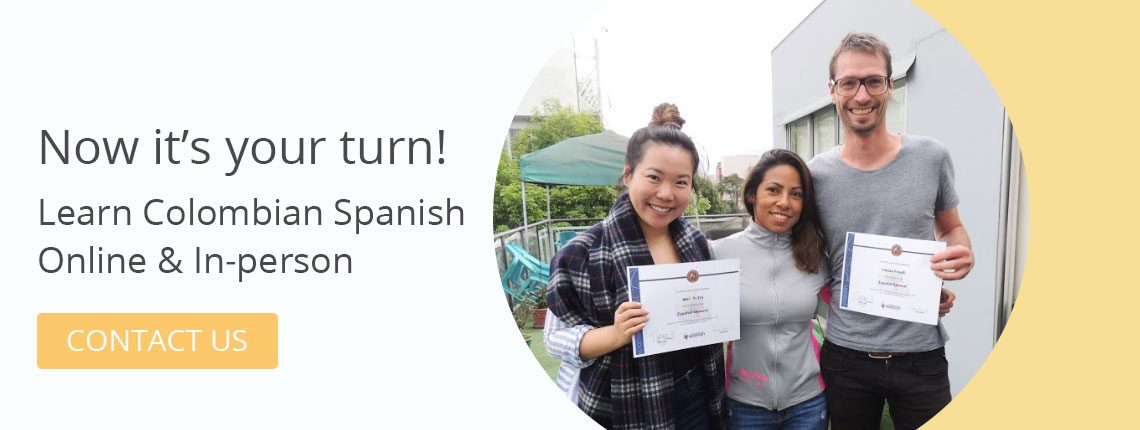
At Learn More Than Spanish, you can join online classes from anywhere or take in-person classes in Bogotá and practice Spanish in real situations.
If you want a friendly and clear way to start learning Spanish, this is a great place to begin.