
Where to stay in Bogotá while learning Spanish
You’ve chosen your Spanish school in Bogotá. Now you need somewhere to stay.
It’s tempting to search for “the best neighborhoods in Bogotá” and start comparing every area that appears in travel guides. But there’s a better place to start: your Spanish school.
If you’ll be going to class several times a week, your school will be one of the places you visit most during your stay. So open the map, find your school and ask yourself:
What do I want the rest of my day in Bogotá to look like?
That simple question can make choosing your accommodation much easier.
Start with your Spanish school, not a list of neighborhoods
When you’re visiting Bogotá for a few weeks, you don’t need to stay close to everything. That’s almost impossible in a city this size.
Instead, try this simple rule:
Stay close to what you’ll do every day. Travel for what you’ll do occasionally.
If you have Spanish class every morning, the trip to school matters. You may visit a museum once, go to Monserrate one afternoon or spend a Saturday exploring another part of Bogotá. Those trips are part of discovering the city.
Traveling a long distance to class every morning is different.
Construction and traffic can affect how long it takes to move around the city, so a place that looks relatively close on a map may not always mean a quick trip to class.
Before comparing neighborhoods, put your Spanish school on the map. That’s your starting point.
Build your Bogotá routine from your school out
Once you’ve found your school on the map, think about your stay in three zones.
1. Your class zone
Start with the area around your Spanish school and ask yourself:
How far am I willing to travel to class every day?
Maybe you’d love to walk. Maybe a short ride is fine. Or maybe you’ve found accommodation you really like and don’t mind traveling a little farther.
There’s no correct distance. What matters is knowing what that trip will look like before you book. A commute that seems fine once can feel very different when you make it several times a week.
And don’t look only at distance. Look at the route too. A place that appears close on a map may involve busy roads, hills or streets you wouldn’t want to walk every morning.
2. Your daily life zone
Next, think about what you’ll need around your accommodation on a normal day.
A supermarket, a place for breakfast, restaurants, a pharmacy and maybe a café where you can sit for a while. If you’re combining Spanish classes with remote work, you might also want a good place to work or a gym nearby.
These everyday places matter because you’ll probably use them much more often than the tourist attractions on your list. They’re also where your Spanish can become part of your day.
You might leave class and order lunch in Spanish, stop at a store on the way home or hear an expression at a café that you learned that morning. Sometimes you’ll understand everything. Sometimes you’ll have to ask someone to repeat themselves.
That’s part of learning Spanish while living in Bogotá: taking what you learn in class and finding opportunities to use it outside the classroom.
3. Your Bogotá zone
Finally, think about everything you want to discover while you’re here: museums, historic streets, parks, markets, restaurants, nightlife and other neighborhoods.
You don’t need to live close to all of them. You’ll have afternoons, evenings and weekends to explore different parts of Bogotá, so these places don’t need to define where you stay.
Instead of asking:
“Which neighborhood puts me close to everything?”
Ask:
“Which neighborhood makes my normal week easier?”
Your Spanish classes and everyday routine will happen again and again. The museum you want to visit or the neighborhood you want to explore can be a trip for another day.
Decide what matters after class
Once you know how far you’re comfortable traveling to class, you can compare the neighborhoods within that area based on the kind of stay you want.
One may put you closer to school but have more nightlife than you want. Another may be a little farther away but have the cafés and quieter streets you’re looking for. A third may offer cheaper accommodation but require transportation every morning.
You’re looking for the right balance between class, daily life and the kind of stay you want.
The closest neighborhood isn’t always the best one for you. But the commute should be a choice, not a surprise.
If you want to walk to class
Start with the streets immediately around your school and check the actual walking route, not just the distance. Being able to walk can simplify your routine and help you become familiar with the cafés, stores and other places around your school.
If you want cafés where you can study or work
If you’re combining Spanish classes with remote work, the closest possible accommodation may not be the best fit.
Maybe your normal day is class in the morning, lunch, a couple of hours of work and then some time exploring Bogotá. In that case, having cafés, restaurants and a comfortable place to work nearby may matter more than saving five minutes on your commute.
Also think about noise. An area that’s active in the evening may not work as well if you need quiet video calls every afternoon.
If you want restaurants and nightlife
Look for a neighborhood that keeps your trip to class manageable while giving you restaurants, bars and places to meet people afterward.
Going out can also give you opportunities to use Spanish: reading a menu, ordering drinks, following a conversation or understanding a joke a little too late.
Just check what’s directly around the building before booking. You may want nightlife nearby without having it right outside your window.
If you prefer somewhere quieter
Look at residential streets around your school rather than assuming you need to stay far away from busy areas.
Sometimes moving only a few blocks can change the atmosphere. The exact street matters, especially if you need to study, work or simply want a quieter evening after class.
If you’re trying to keep costs down
A cheaper room isn’t always a cheaper stay.
If you’re attending Spanish classes several days a week, transportation becomes part of your budget. An apartment that costs a little more but lets you walk to class, buy groceries nearby and do most of your daily activities without traveling far may work out better than a cheaper option with a long commute.
Compare:
Accommodation + transportation + time
Not just the nightly price.
If you’re planning a longer stay, we’ve also looked at what one month in Bogotá can do for your Spanish and why what happens outside class matters too.
If you want more opportunities to use Spanish
Look beyond the apartment itself.
Are there bakeries, cafés, small stores, supermarkets and restaurants nearby? Can you do some of your normal activities on foot?
Maybe you practice ordering food during class and use it at lunch an hour later. Maybe you learn how to ask for something and try it at a store. Or maybe you don’t understand what the cashier says and ask your teacher about it the next morning.
These everyday places can give you useful opportunities to practice. If you want more ideas, here are some places to practice Spanish in Bogotá.
Living in Bogotá doesn’t automatically make your Spanish better. You still have to make the effort to use it. But your daily surroundings can give you more chances to do that.
Now think about the kind of neighborhood you want
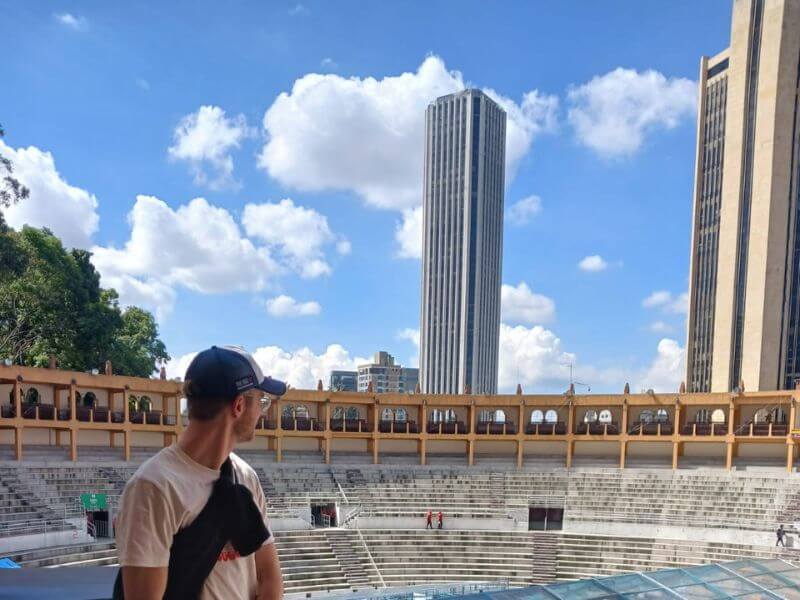
Once you know how far you’re willing to travel to class, you can start thinking about what you want around you for the rest of the day.
Bogotá offers very different neighborhood experiences. You might want cafés and restaurants, quieter residential streets, nightlife, or history and culture just outside your door.
The areas below aren’t a ranking or a complete list. They show some of the different options you can find in Bogotá. Use them to think about what fits your stay, then check how that area works with the location of your Spanish school.
Quinta Camacho
Choose it if: you like cafés, restaurants and having places nearby where you can work, study or spend part of the afternoon.
Quinta Camacho is known for its tree-lined streets, older houses, cafés, restaurants and cultural spaces. It can be especially appealing if you’re combining Spanish classes with remote work or enjoy spending time in your neighborhood after class.
Keep in mind: it’s an active restaurant and café area, so check what’s directly around your accommodation if having a quiet place to work or sleep is important to you.
Zona T and El Retiro
Choose them if: restaurants, nightlife and having plenty to do after class are high on your list.
You’ll find a strong concentration of restaurants, bars, cafés, shops and entertainment, making this one of the easier areas to keep your evenings busy.
Keep in mind: some streets can be lively and noisy at night and on weekends. Accommodation, eating out and entertainment may also cost more here than in other areas.
Rosales
Choose it if: you’d rather return to more residential surroundings after class.
Rosales combines residential streets with access to restaurants and everyday services, giving you a different atmosphere from Bogotá’s busier nightlife areas.
Keep in mind: the hills matter. Some streets are steep, so check the actual walking route to the places you’ll use regularly.
Parque 93
Choose it if: you want restaurants, cafés and plenty happening around you.
The area around Parque 93 combines restaurants and cafés with entertainment, events and places to spend time outside.
Keep in mind: there’s a lot of activity around the park, especially near restaurants and events. If you prefer quieter surroundings, check what’s directly around your accommodation before booking.
If you like this part of Bogotá but prefer more residential surroundings, the area around Parque El Virrey can also be worth considering.
Usaquén
Choose it if: you want a neighborhood where you can spend a good part of your free time without going elsewhere.
Around the historic center of Usaquén, you’ll find older streets, a central plaza, restaurants, cafés, shops and the well-known weekend market. Its history and distinct neighborhood feel make exploring the area part of the experience of staying there.
Keep in mind: Usaquén extends across a much larger area, so check exactly where your accommodation is located. If you’re staying farther north, getting to other parts of Bogotá can become a bigger part of your day.
La Candelaria
Choose it if: history, museums and culture are a big part of why you want to spend time in Bogotá.
Staying in Bogotá’s historic center puts museums, universities, cafés, galleries, architecture and street art around you. For a Spanish student, it can also add cultural context to what you’re learning in class.
Keep in mind: the atmosphere can change after museums, universities and other daytime activities wind down. If you’re considering staying here, check the exact street and think about how you’ll get home when you’re out in other parts of Bogotá at night.
What about safety when choosing where to stay in Bogotá?
As in any large capital city, Bogotá has areas and streets that are better to avoid, especially at certain times of day. That’s why it’s worth looking beyond the neighborhood name when choosing where to stay.
Before booking, check the exact location, the route to your Spanish school and how you plan to get around during the day and at night. Street View and recent reviews can also help you get a better sense of the immediate area.
If you’re unsure about a location, ask your Spanish school. They can give you local context about the area and the route you’ll be using regularly.
The goal is to choose a place where you understand your surroundings and feel comfortable with your daily routine.
What should you check before booking?
Once you’ve found an apartment you like, imagine a normal weekday there. How will you get to class? Where will you eat? What will you do after class? How will you get home in the evening?
Before booking, check:
- How long will it take to get to my Spanish school?
- Can I walk, or will I need transportation?
- Would I be happy making that trip several times a week?
- What is the route to class like?
- Can I find groceries, breakfast and lunch nearby?
- Are there cafés or places where I can study or work?
- What is directly around the building?
- How much will transportation add to my budget?
- Does this location give me opportunities to spend time outside and use Spanish?
- Have I asked my Spanish school about the area I’m considering?
Check the area at the times you’ll actually use it too. If possible, look at recent reviews and Street View, and check your route to class in the morning and your options for getting home in the evening. A trip across Bogotá can feel very different depending on the time of day. Our guide to getting around Bogotá can help you understand some of your transportation options.
What if you’re studying at Learn More Than Spanish?
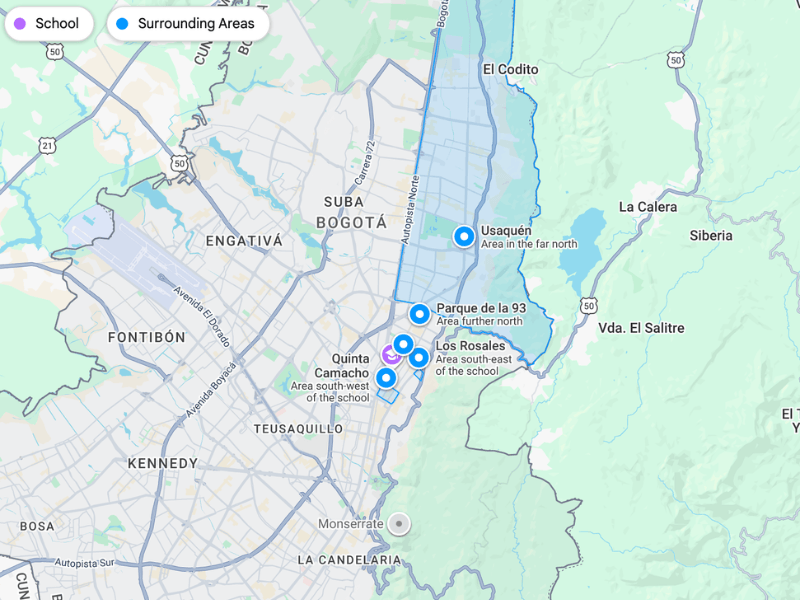
Now let’s apply the same idea to our school.
Learn More Than Spanish is in Chapinero, around Calle 77. Chapinero covers a large and varied part of Bogotá, so simply searching for accommodation “in Chapinero” doesn’t tell you much about what your daily experience will be like.
Instead, use the school as your starting point. Look at the accommodation you’re considering, check the route to class and then think about what you’ll have around you for the rest of the day.
How far are different areas from Learn More Than Spanish?
We used a representative point in each area to give you a general idea of what your trip to class could look like.
| Area | Approx. distance to LMTS | Approx. travel time to LMTS | Why you might choose it |
|---|---|---|---|
| Zona T / El Retiro | About 0.8 km | About 10 min walk | Restaurants + nightlife |
| Quinta Camacho | About 1.1 km | About 15 min walk | Cafés + neighborhood character |
| Rosales | About 1.2 km | About 15–20 min walk | More residential surroundings |
| Parque 93 | About 2.2 km | About 10–20 min by car | Restaurants + entertainment farther north |
| Usaquén | About 9.1 km | About 25–45 min by car | Its own neighborhood experience farther north |
These distances and travel times are approximate and use a representative point in each area. Your actual trip will depend on the exact location of your accommodation, the route, time of day and traffic.
Distance isn’t the whole story in Bogotá. Check the route from the specific accommodation you’re considering at the times you’ll normally travel to class.
Frequently asked questions about where to stay while studying Spanish in Bogotá
What are the best areas to stay in Bogotá while studying Spanish?
The best area depends first on the location of your Spanish school and the kind of routine you want outside class. Once you know how far you’re comfortable traveling, compare the areas within that range based on what matters to you, such as cafés, restaurants, nightlife or quieter residential surroundings.
Is it better to walk or take transportation to Spanish class in Bogotá?
Walking can make your daily routine simpler, but you don’t need to live within walking distance to have a good experience. A short bus, TransMilenio or car trip may be a reasonable trade-off if you prefer the neighborhood, accommodation or price.
Check the route at the time you’ll normally go to class, not just the distance shown on the map.
Where should I stay in Bogotá for a one-month Spanish course?
For a one-month stay, look for a location that makes your normal week easy. Consider the trip to class, groceries, places to eat, cafés or workspaces, transportation and what you’ll find around your accommodation.
Tourist attractions don’t need to be within walking distance. You can explore other parts of Bogotá in the afternoons and on weekends.
Should I choose my Spanish school before booking accommodation in Bogotá?
If studying Spanish is one of the main reasons for your trip, choosing your school first can make finding accommodation much easier. Once you know where your classes will be, you can decide how much travel you’re comfortable with and compare neighborhoods within that range.
If you’ve already booked accommodation, check the route to the schools you’re considering before enrolling.
Do I need to stay in a tourist area while studying Spanish in Bogotá?
No. If you’re staying for several weeks, having groceries, restaurants, transportation and an easy trip to class nearby may be more useful than living next to Bogotá’s main attractions. You can visit areas such as La Candelaria, Usaquén or Monserrate when you have time to explore.
Can where I stay help me practice Spanish?
Yes. Staying near cafés, bakeries, restaurants, supermarkets and other places you use regularly can give you more opportunities to hear and speak Spanish outside class.
The location alone won’t improve your Spanish, though. You still have to make the effort to use it.
Your Spanish school is your starting point, not your whole map
Choosing accommodation for a Spanish course in Bogotá doesn’t have to begin with a list of the city’s “best neighborhoods.”
You’ve already made one important decision: where you’re going to study.
Put your school on the map, decide how far you’re comfortable traveling several times a week and then look at the neighborhoods inside that area.
From there, think about the life you want around your classes. Cafés where you can study? Restaurants and nightlife? Quieter residential streets? History and culture? More opportunities to use Spanish during your normal day?
You don’t need to stay close to everything in Bogotá.
Stay close to the life you’ll live most days, and explore the rest of the city from there.
Planning to study Spanish in Bogotá?
Finding the right place to stay is one part of planning your time in Bogotá. Finding Spanish classes that fit your level, goals and schedule is another.
At Learn More Than Spanish, you can take private 1:1 classes or join a small group of up to 3 students, with certified teachers and a learning plan adapted to you.
And when class is over, Bogotá gives you plenty of opportunities to put your Spanish into practice.
Start with a free trial class and see what learning Spanish with us is like.



